
Outdoor Climate Adaptation in Mediterranean-Influenced Housing Markets
The European Environment Agency reports that Mediterranean regions are experiencing more frequent heatwaves, longer dry periods, and increasing climate-related pressures on urban and residential environments. These shifts are influencing how homes are designed, renovated, and managed across Southern Europe, where outdoor living has long been an essential part of daily life.
Housing markets influenced by Mediterranean climate patterns are increasingly adapting through architectural solutions that balance comfort, energy efficiency, and environmental resilience. Design resources and case examples, including information related to bioclimatic pergola in Croatia (bioklimatska pergola u hrvatskoj), illustrate how outdoor structures are becoming part of broader climate adaptation strategies. Rather than relying exclusively on mechanical cooling systems, many homeowners and developers are exploring passive design techniques that respond directly to local weather conditions.
Mediterranean Climate Conditions and Their Impact on Housing
Mediterranean climates are generally characterized by hot, dry summers and mild, wetter winters. While these conditions have traditionally supported outdoor lifestyles, climate change is intensifying seasonal extremes. Research from the Intergovernmental Panel on Climate Change (IPCC) indicates that Mediterranean regions are among the world’s climate change hotspots, facing increased temperatures and heightened risks of drought.
These environmental changes affect residential buildings in several ways. Higher summer temperatures can increase cooling demands, while prolonged sun exposure accelerates material degradation on façades, roofs, and outdoor spaces. Data from the European Commission Joint Research Centre suggests that urban heat island effects further amplify temperature stress in densely developed coastal and inland communities.
As a result, housing markets throughout Croatia, Spain, Italy, Greece, and other Mediterranean-influenced regions are placing greater emphasis on climate-responsive design. Buyers and property owners increasingly consider factors such as solar exposure, outdoor comfort, ventilation quality, and energy performance when evaluating residential investments.
Architectural Adaptation Strategies Across the Region
Climate adaptation in housing often begins with passive design principles. These strategies aim to reduce heat gain and improve comfort without excessive dependence on air conditioning systems.
Experts from the International Energy Agency (IEA) note that passive cooling approaches can significantly lower building energy consumption when properly integrated into architectural planning. Common adaptation strategies include:
- Building orientation that minimizes direct solar exposure during peak afternoon hours.
- Use of reflective or light-colored exterior materials.
- Improved insulation and thermal mass management.
- Natural cross-ventilation systems.
- Strategic landscaping with trees and vegetation.
- Shaded terraces, balconies, and outdoor gathering areas.
Many of these methods have historical roots in traditional Mediterranean architecture. Thick stone walls, internal courtyards, narrow streets, and covered outdoor spaces have long helped communities manage heat naturally. Contemporary housing developments often reinterpret these concepts using modern materials and engineering techniques.
What distinguishes current adaptation efforts is the growing integration of environmental performance goals with lifestyle expectations. Homeowners increasingly seek outdoor areas that remain usable during warmer months while minimizing additional energy consumption.
The Expanding Role of Outdoor Living Spaces
Outdoor living areas hold particular importance in Mediterranean-influenced housing markets. Patios, terraces, courtyards, and gardens often function as extensions of interior living spaces for much of the year.
However, rising temperatures present challenges for maintaining comfort in these environments. Research published by the World Health Organization (WHO) highlights the growing public health risks associated with extreme heat exposure, particularly among vulnerable populations. Creating shaded outdoor environments therefore serves both comfort and resilience objectives.
Designers increasingly view outdoor shading systems as essential infrastructure rather than decorative additions. Effective shade can reduce surface temperatures, improve thermal comfort, and help protect building materials from prolonged ultraviolet exposure.
Several solutions are commonly employed across the region:
- Fixed pergolas and covered terraces.
- Retractable awnings.
- Vegetated trellises and green shading systems.
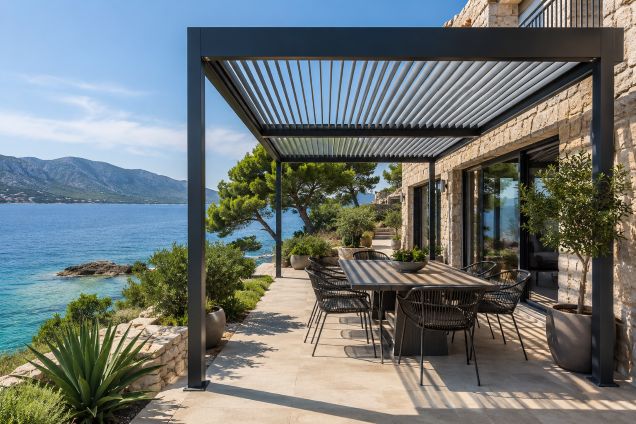
- Adjustable louvered roof structures.
- Integrated outdoor cooling and ventilation features.
Each option offers different advantages depending on local climate conditions, property orientation, maintenance requirements, and user preferences. The broader trend reflects a shift toward adaptable outdoor environments capable of responding to changing weather conditions throughout the day and across seasons.
Case Study: Climate Adaptation Through Bioclimatic Outdoor Design in Croatia
Croatia provides an informative example of how Mediterranean-influenced housing markets are responding to environmental pressures. Along the Adriatic coast, communities experience strong solar radiation during summer months combined with growing tourism activity and increased demand for comfortable outdoor spaces.
Property owners face the challenge of maintaining usable exterior environments without substantially increasing energy consumption. This has encouraged greater interest in climate-responsive outdoor structures designed to regulate sunlight and airflow.
Bioclimatic pergolas represent one example of this approach. Unlike conventional fixed-roof structures, these systems typically use adjustable louvers that can be opened or closed depending on weather conditions. This flexibility allows users to manage solar exposure, encourage natural ventilation, and improve outdoor comfort.
From an environmental perspective, the value of such systems lies in their adaptability. During hot periods, adjustable shading can help reduce heat accumulation on adjacent building surfaces. When temperatures are milder, increased airflow can support natural cooling strategies. These characteristics align with broader regional goals of reducing energy demand while enhancing resilience to climate variability.
The Croatian experience mirrors developments occurring throughout Mediterranean housing markets. Rather than focusing solely on indoor climate control, architects and property owners increasingly view the entire building envelope, including outdoor spaces, as part of a comprehensive environmental strategy.
Broader Environmental and Market Implications
The evolution of outdoor climate adaptation reflects larger changes in housing priorities. Environmental resilience is becoming a practical consideration rather than a niche design preference.
Studies from UN-Habitat indicate that climate-responsive urban development can improve livability while supporting long-term sustainability objectives. Housing markets that successfully integrate adaptive design measures may be better positioned to address future environmental challenges. These efforts are often connected to broader environmental preservation strategies that encourage responsible resource management, resilience planning, and the protection of natural assets for future generations.
At the same time, outdoor climate adaptation contributes to multiple goals beyond thermal comfort. Well-designed shaded spaces can support social interaction, encourage outdoor activity, protect landscaping investments, and extend the functional use of residential environments.
As temperatures continue to rise across many Mediterranean regions, demand for adaptable outdoor infrastructure is likely to increase. Homeowners, developers, and policymakers are recognizing that environmental resilience often emerges from a combination of traditional design wisdom and modern technological innovation.
Conclusion
Mediterranean-influenced housing markets are adapting to a changing climate through increasingly sophisticated architectural responses. Rising temperatures, prolonged heat events, and evolving sustainability expectations are reshaping how residential properties manage both indoor and outdoor environments.
Passive cooling strategies, climate-responsive building design, and advanced shading systems are becoming important tools in this transition. The growing use of adaptable outdoor structures, including examples seen in Croatia, illustrates how regional housing markets are responding to environmental realities while preserving the outdoor lifestyles that define Mediterranean living. These developments demonstrate that effective climate adaptation often begins with thoughtful design choices that work with local conditions rather than against them.